Rainforest Animal and Plant Vocabulary for Kids
Rainforest vocabulary includes English words for tropical forest animals, plants, places, and actions. Rainforest Animal and Plant Vocabulary for Kids: Words and Activities helps families build language through pictures, movement, questions, and short games. Begin with nouns such as monkey, tree, and frog. Then add adjectives and verbs, including green, climb, and hide. Children remember words when they hear them, see their meaning, say them aloud, and use them with purpose.
Core Rainforest Words and Phrases
Group new words by meaning, not in one long mixed list. Pictures can show animals and plants; place words and verbs help children form complete sentences. A lesson may combine one noun group with two or three actions.
Rainforest Animal and Plant Vocabulary for Kids: Words and Activities works best when each word has a picture, gesture, or brief definition. A child might stretch both arms upward for grow, move one hand sideways for slither, or point overhead for canopy. Each link conveys meaning without depending on translation.
Using the Words in Context
Move from single words to short phrases once your child understands the pictures. Say a green frog, a tall tree, two bright parrots, or a jaguar near the river. Your child then practises colour, size, number, and place language together.
Ask questions that invite full answers: “What can you see?”, “Where is the toucan?”, and “What is the snake doing?” Accept “On the branch” before modelling “The toucan is on the branch.” Modelling adds grammar without making every response a correction.
When Rainforest Animal and Plant Vocabulary for Kids: Words and Activities serves as a speaking prompt, one picture supports several language levels. A younger child may say, “Frog.” A more confident learner can say, “The small frog is hiding under a leaf.” Older children can explain why an animal hides or compare two plants.
How to Introduce New Rainforest Vocabulary
Start with a picture walk. Study a rainforest scene and name only the words needed for the first task. Point, pronounce each word, and pause for repetition. Mix recognition questions such as “Where is the fern?” with choices such as “Is this a fern or a vine?”
Follow recognition with recall. Cover the labels, point to an item, and ask your child to name it. If the word does not come, give the first sound or two choices. A quick prompt keeps the exchange calm and offers another retrieval attempt.
Finish with personal or imaginative questions: “Which animal would you like to see?”, “Would you climb this tree?”, or “What might be under the leaf?” Across LearnLink lessons, our tutors match questions to each learner’s language level instead of expecting identical answers.
Activities for Different Ages
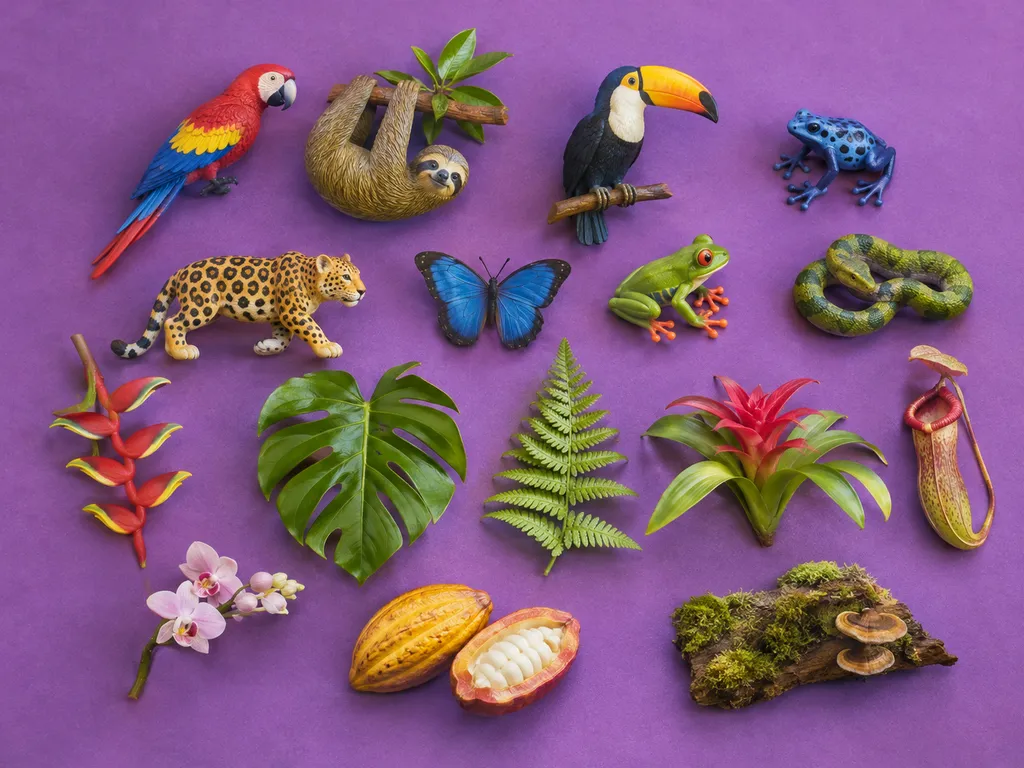
Rainforest Animal and Plant Vocabulary for Kids: Words and Activities can suit different learners without changing the main word set. For school-age kids, place animal and plant pictures on a table. Give commands such as “Touch the frog,” “Put the butterfly by the flower,” or “Make the monkey climb.” Movement shows meaning.
For school-age kids, play a guessing game. One person chooses a picture and gives clues: “It is an animal. It has wings. It can fly. It has a large beak.” The other person guesses toucan. Children can read prepared clue frames before creating their own.
For school-age kids, turn a labelled scene into a short report, dialogue, or comparison. Learners can compare the canopy and forest floor, describe an animal’s position and actions, or explain how a seed becomes a plant. Older learners can add precise terms while retaining the core sentences.
Short Practice Ideas for Home
Keep practice brief and switch tasks before words become dull. Sort picture cards into animals and plants, play “odd one out,” draw from spoken instructions, or hide a card and identify the missing word. Reuse the same words on different days in a new order.
Build a Rainforest Scene
Draw a tree, a river, and three plants. Add two animals. Take turns giving instructions such as “Put the frog under a leaf” and “Draw a parrot above the river.” Finish by describing the whole picture in three or more sentences.
Reading provides focused repetition. Before a rainforest story or information text, choose target words to find. After reading, ask your child to point to each item, use it in a sentence, or explain it without naming the word. This tests meaning and memory.
Common Mistakes and Helpful Corrections
Children may omit articles and say “Jaguar is hiding.” Model “A jaguar is hiding” or “The jaguar is hiding” according to the picture. They may forget plural endings: “Two parrot” becomes “Two parrots.” Repeat the corrected sentence naturally, then continue.
Place words can cause confusion. An animal may be in the trees, on a branch, under a leaf, or near the river. Show each relationship with toys, cards, or hand movements. Concrete examples replace lengthy grammar explanations.
Do not demand identical pronunciation across English accents. Words such as jaguar vary between English-speaking regions. Aim for intelligible speech. In multilingual families, a child may connect a new English word to another language; that link supports learning until the English word becomes automatic.
- Choose five rainforest words and ask your child to sort animals from plants.
- Point to one picture and model the correct word before requesting repetition.
- Contrast two confusing words, then use each one in a simple sentence.
- Revisit mistakes kindly and invite your child to explain the corrected choice.
- Create four matching cards pairing rainforest animals and plants with clear labels.
When a word has several meanings or pronunciations, Cambridge Dictionary is a useful check before turning it into child-friendly examples.
Frequently Asked Questions
How Many Rainforest Words Should My Child Learn at Once?
Begin with a small set your child can recognise and use, then add words gradually. Rainforest Animal and Plant Vocabulary for Kids: Words and Activities should support speaking, not test memory with a long list. Retain familiar words in later games while introducing new ones. A word is ready for review when your child can identify, say, and use it in a short phrase.
Should Younger Children Learn Scientific Animal and Plant Names?
Everyday words such as frog, snake, fern, and vine suit most younger learners. Add scientific or species names when a child shows interest or needs them for school. Explain that a specific name identifies one kind within a larger group, while keeping practice focused on English sentences.
Can Multilingual Children Use Their Other Languages During Practice?
Yes. A known word in another language can help your child grasp a new English meaning. After making the connection, return to the English picture, phrase, or question. Avoid translating every sentence repeatedly; connect English directly with the animal, plant, action, or idea. Multilingual knowledge is a resource, not an error.
How Often Should We Review Rainforest Vocabulary?
Use short reviews across several days instead of one long session. A child might sort pictures one day, follow drawing instructions the next, and play a guessing game later. Revisit slow words and include familiar ones to build confidence. Stop while the activity remains purposeful, then return to the word set in a fresh context.
Try three steps today: choose six rainforest words, practise each with a picture and action, then ask your child to use three in complete sentences. Review the same set twice more this week before adding new vocabulary.
Start your child's English journey today — book a trial lesson with LearnLink.
Stay updated on our latest tips and resources by following us on Instagram LearnLink.